

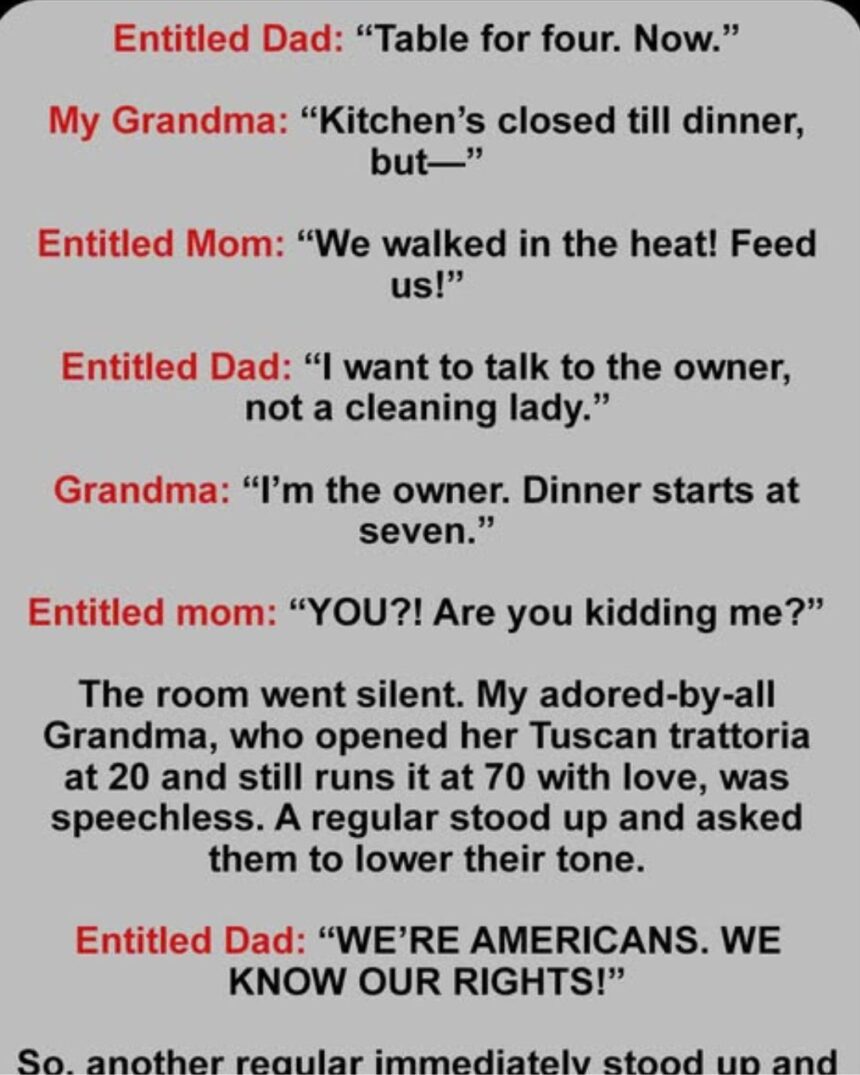
When entitled tourists insult Aurora’s grandmother during a quiet afternoon at the family restaurant, the room holds its breath. What follows is a lesson in grace, loyalty, and the kind of justice that doesn’t need shouting to be heard. Some tables are sacred…
and some guests forget where they’re sitting. There are some places the soul never leaves, even when life tries to pull you away. For me, that place has always been the little trattoria tucked between the sun-warmed stone streets, where rosemary and garlic cling to the air.
It is called Trattoria di Luce and it carries my grandmother’s name, Lucia. She opened the restaurant at 20 with my late grandfather, building it from scratch with their bare hands. He laid the stones.
She made the sauce. Together, they poured their whole lives into it, from cooking, cleaning, and serving, to laughing, and mourning. And when he passed away, she didn’t stop.
Even in her 70s, Nonna Lucia wakes before the first rooster call, ties on her apron, kneads the dough from memory, and greets her guests like they’ve come home. It’s more than just a restaurant. It’s a living thing.
The walls hum with stories. The tables remember elbows from every generation. The scent of fresh herbs and garlic seems to live in the wood itself.
My grandmother is the kind of woman who remembers your name, your mother’s name, and whether you like your sauce with extra basil. She once fed half of our town during a blackout, by candlelight, with bread she’d baked that morning and the last of the tomatoes from her garden. Growing up, I didn’t fully understand what it meant to belong to something like this.
I just knew that the smell of simmering ragu on a Saturday afternoon could undo a bad week. I knew that every person who walked through our door left with more than a full stomach… they left seen.
This past summer, I came home from university to help her for a few weeks. I thought I’d just be bussing tables and preparing produce in the kitchen. But something about being there, being beside my grandmother, reignited a part of me I hadn’t realized was fading.
It was the kind of summer you want to bottle: warm air, full tables, the sound of clinking glasses and forks twirling pasta. “You’re a romantic like your grandfather, Aurora,” my grandmother said when I told her I wanted to bottle everything up. “It’s a part of him that I miss the most.”
The trattoria was thriving, locals lingered after their tiramisu, and tourists leaned in for photos with the menu chalkboard.
We were in a rhythm. A beautiful and seamless one. Until they showed up.
It was riposo time, our sacred midday break. It may be old-fashioned to some people but it was something that my grandmother swore by. “It’s tradition, Aurora,” Grandmother Lucia told me.
“I know that in a way, we lose money and customers during that time. But your grandfather swore by it, and we will too.”
I knew that my grandmother wanted to hold onto tradition but I suspected that she really needed that downtime, given her age. The dining room was half-empty, the kitchen was closed and Gran was sitting in a rocking chair in the corner, behind the counter.
Espresso was still warm in half-finished cups, and two uniformed officers sat in the corner playing a quiet game of cards. The hum of soft conversation mixed with the clinking of ceramic cups and the scent of citrus from freshly mopped floors. There was a stillness to it, like the entire restaurant was exhaling.
That was when the door flew open. It slammed harder than it needed to, the sound cutting through the calm like a blade. “Table for four.
Now,” barked a man in a sweat-stained polo shirt, his voice far too loud for the quiet house. He didn’t even look around. He didn’t acknowledge anyone.
He just stood there, panting slightly, already annoyed. My grandmother turned from the counter, smiling as always. She didn’t flinch.
She didn’t let the tension ripple across her face. “Hello!” she said. “I’m afraid the kitchen is closed until dinner.
We’d love to have you back later!”
“Excuse me?!” the woman behind him snapped. Her sunglasses were pushed to the top of her head, her face flushed with heat and entitlement. “We walked half a mile in this heat.
We have children! Feed us, lady. It’s not that hard.”
It was like watching a storm gather in fast-forward.
One of the kids immediately yanked on a cloth napkin, sending it fluttering to the floor. The other bolted toward the kitchen doors. I moved instinctively, stepping forward from where I’d been organizing wine bottles, blocking his path gently with my arm.
“Hey, little one,” I said, lowering my voice. “The kitchen’s not safe right now.”
But their father had already turned his attention to my grandmother, eyes narrowed, lips twisted into something that might’ve passed for a smirk in a different context. “Can we at least get some real service?” he said, looking her up and down like she was invisible.
“Who even are you? The cleaning lady? You’re a bit old for this, don’t you think?”
My blood ran cold.
A line had just been crossed and I felt it in every inch of me. My grandmother, who had just refilled a sugar bowl by hand, who had served food to the mayor and the local church priest, smiled and answered simply. “I’m the owner.
It’s my name on the door. The dinner service starts at seven.”
There was no edge to her voice. No challenge.
The story doesn’t end here — it continues on the next page.
Tap READ MORE to discover the rest 🔎👇