

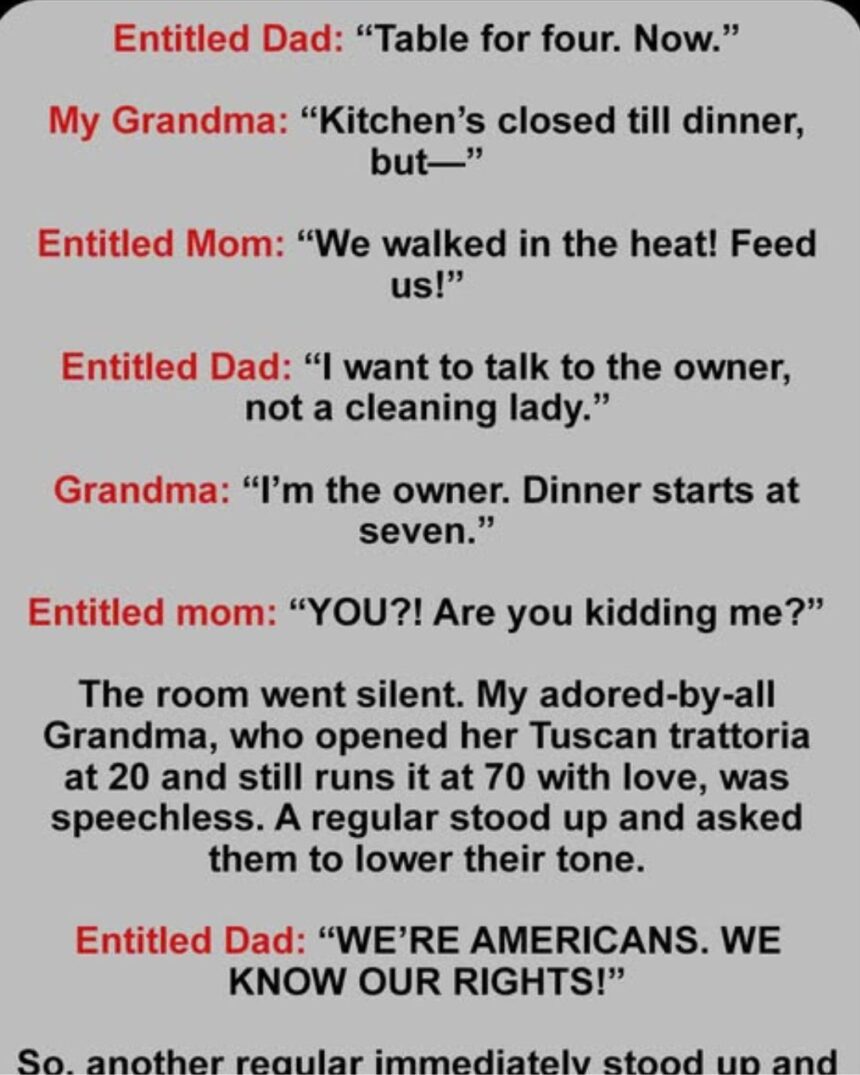
Just grace. “This dusty old place is yours? That explains everything,” the man laughed.
It wasn’t the words that stung. It was the way he said “yours,” like the idea that someone like my grandmother could own something was absurd. Like everything we had built here wasn’t worth the worn tiles beneath our feet.
Before I could say a word, the woman scoffed, marched up to a table, grabbed a menu, and tossed it onto the floor. “This is ridiculous!” she shouted. “You can’t treat people like this!
We’re paying customers, lady! Just like everyone else that walks through these doors.”
The room stopped breathing. A fork hung suspended halfway to a mouth.
A coffee cup sat poised in midair. Even the espresso machine, which had been steaming quietly behind me, seemed to sigh and fall silent. I could feel the collective weight of every regular in the room, every person who’d ever celebrated a birthday here, or worked away on their laptops, or even mourned a loss over a bowl of hot lentil soup, rise to their feet, silently or otherwise.
From the corner, one of the faces I’d seen every single day in my childhood, stood. Marco. He adjusted his coat, buttoned it like he was preparing to go outside, though he didn’t move.
He simply looked at the woman with steady eyes and cleared his throat. “Ma’am,” he said, his voice low and firm. “This is a family establishment, please, lower your voice.”
The man wheeled around like he’d been challenged in a bar fight.
“Mind your own business, man. We’re here on holiday. We know our rights!
You can’t refuse us food!”
That line hit the room like a slap. It was so loud, so arrogant, so misplaced in a space that had never needed loudness to feel full. Bad move.
Both officers at the corner table stood. I hadn’t even noticed them rise. Their expressions were unreadable but the shift in their posture was unmistakable.
“Sir,” said the older one, Officer David. “Your rental car is parked across two handicapped spaces. We saw you park while we were drinking our coffee, so you lied about walking here…
We were just about to address it.”
“And on top of that,” his partner added. “You’ve just verbally assaulted this woman in her place of business. That qualifies as disorderly conduct.”
“Are you serious?” the woman demanded, taking a step back.
“For this… for this… run-down restaurant?”
“Please come with us,” Officer David said.
“We’ll sort this out at the station.”
And just like that, they were escorted out loudly, defiantly, protesting every step. The children trailed behind, confused and embarrassed, their voices hushed now, their energy collapsed. The door shut behind them like the closing of a book we never wanted on the shelf in the first place.
For a moment, the silence was thick. Nobody spoke. Then came the applause.
It wasn’t the kind meant for spectacle. It was the kind people give when they’ve witnessed something honest, quiet, gentle, a few claps here and there, then building to something soft and unified. It was gratitude without fanfare.
As they passed, the smaller of the two boys paused. He peeked around his father’s side, eyes wide and remorseful. Then, just before they disappeared, he smiled sadly.
“Sorry, Grandma,” he said. My grandmother smiled, her eyes kind as ever and placed a wrapped biscotti in his palm. “Here you go, son,” she said.
“For your journey.”
After they left, Elena, one of our longest-standing regulars, walked over, took my grandmother’s hand, and kissed it. “Some people don’t deserve your food, Lucia,” she said. “I hope they find peace,” Gran said, chuckling as she wiped her hands on her apron.
“But not at my table.”
Later that evening, as the golden light stretched over the tiled rooftops and the scent of basil, garlic, and woodsmoke settled into the dusk, Officer David and his partner returned for dinner. “Lucia, this is the best food we’ve ever had,” he said, clinking his glass and smiling. He took a bite of her eggplant parmigiana.
“But today? The show was better.”
Laughter returned. The restaurant felt like itself again.
But something lingered. Something still sitting in my chest like a stone I hadn’t acknowledged. After we cleaned and locked up, I found Nonna on the stone bench outside the back door, the one overlooking the olive grove.
She sat there with her hands folded in her lap, staring at the horizon where the last lavender hues of sunset were giving way to stars. I walked over with two cups of gelato and sat beside her. She took hers without a word, but her smile said everything.
For a few minutes, we just sat in silence, listening to the cicadas and the rustle of wind through olive branches. “I’m sorry,” I said, finally breaking the quiet. “For what, baby girl?” she asked gently, spoon paused in mid-air.
“For them. For how they spoke to you. For how they made you feel.
For thinking they could walk in here and treat you like less than the pillar you are.”
“Ah, Aurora,” she smiled. “Don’t carry shame that doesn’t belong to you.”
I nodded but the lump in my throat didn’t disappear. “I just…” I hesitated.
“I’m so proud of you. Of everything you’ve built. I think…
I forget, sometimes, just how much you’ve done. How far this little place has come because of you.”
She didn’t speak for a moment. Then she reached over and touched my wrist.
“And I’m proud of you. For standing tall. For protecting this place.
For understanding that food is not just about filling bellies. It’s about dignity. About love…
and about memory.”
I looked up at the night sky and smiled. “There’s always a seat at the table, Aurora. Especially for people who deserve it.”
And in that moment, with melting gelato, I understood that what we serve isn’t just food.
It’s legacy. And love. And the quiet, unshakable power of standing your ground…
with grace. Source: amomama