

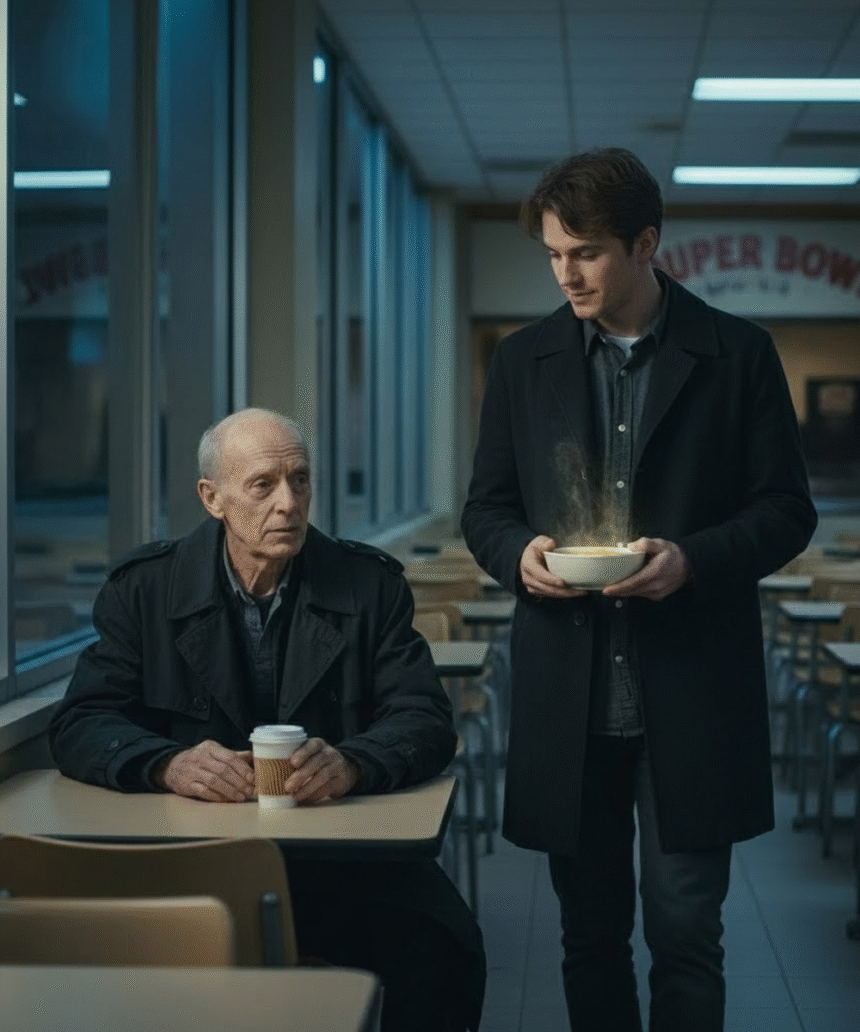
I was twenty-seven, pulling espresso shots in a fading food court off Interstate 89—the kind of place where the air smelled like stale fryer oil and wet wool, and the lights buzzed like they were tired of their own jobs. A high-school hockey team had taken over the molded chairs, ricocheting fries like catapults. Above register three, my manager’s new black camera dome stared down like an unblinking eye.
That’s when I saw him—an elderly man in a pressed black coat, standing by a drooping ficus as if the world he belonged to had quietly moved on without him.
His tie was ironed, his posture careful, his dignity intact but fragile.
I grabbed the emergency folding chair we kept by the mop sink, wiped it, and waved him over.
“It’s not glamorous,” I said, “but it’s warm.”
He offered a small, grateful half-smile.
“I seem to have… forgotten my wallet.”
“I’ve got you,” I said, already sliding eight crumpled bills from my tip jar. A clam chowder from Hank’s grill; a coffee from my station.
No speeches. No fuss.
He ate slowly, folded his coffee lid into a perfect square, and stared through the rain-smeared skylight like he was listening to an old song only he could hear.
“My wife used to sit with me right there,” he murmured.
“Back when this place had fresh paint and plans.” He looked at the empty chair beside him.
“Her name was Ruth.”
When he finished, he rested a steady hand on my shoulder. “You’re a decent kid.”
“It was just soup and coffee,” I mumbled.
“That’s what makes it decent,” he said, and asked my name.
“Elliot.”
He nodded. “Keep that chair open.
Someone else will need it.”
He stepped into the freezing rain and was gone.
The next morning, my manager, Vernon—clipboard raised like a gavel—herded me under camera three’s red light.
“Unauthorized distribution of product,” he announced, producing a grainy printout: me, sliding a tray across the counter like a felon on security footage.
“I paid for it,” I said.
“Out of my tips.”
“The POS doesn’t accept tips,” he replied, savoring the sentence. “This isn’t a soup kitchen.” He clicked his pen.
Twice. “Effective immediately—twelve hours a week, prep only.
Final warning.”
By lunch, I was bleaching drains until my eyes burned, counting lids like they were gold coins.
Hank, at the next stall, slipped a wrapped hot dog onto my sanitizer tray and muttered, “He’s been gunning for you.”
I worked my shift with a throbbing thumb and a new kind of clarity. If kindness could be punished, maybe I could make it harder to catch.
The first spark came from Rosa, a retired math teacher in a fleece jacket that smelled of eucalyptus. She bought coffee and fries, then held out a five.
“This,” she said, tapping the bill, “is for the next person who needs it.”
No policy covered generosity.
So I rang a training ticket, stapled the receipt to a dusty corkboard by the hot-water spout, and wrote in red: Next One’s Covered.
People noticed.
A tired young woman hovered, eyes on the board as if it were written in a language she almost remembered.
“Pick one,” I said. She chose Soup + Small Drink and whispered, “Thanks,” like a secret.
By Thursday, the board looked like ivy—slips pinned with notes: For someone who’s had a day. For a tired mom. For the next guy who gets dumped. When the drawer needed settling, I slid a dollar from my own jar and said nothing.
Hank warned me softly—“Managers like him turn good into write-ups”—but he kept ladling soup a little fuller when a slip came down.
For the first time in months, the job felt like something more than survival. Decency had found a paper trail.
Friday lunch staggered to life.
I was restocking mustard when a voice cut through the vent hum and tinny mall music.
“Elliot Webb.”
The man in the gray suit didn’t look at the menu.
He carried a leather folder and a certainty that bent the room around him. “Is a Mr. Vernon on site?
This concerns operations.”
Vernon appeared, tie crooked, binder ready.
The man unsnapped the folder. “Franklin Shore. Attorney for the estate of Milton Wear.”
My heart stuttered.
Milton—the man in the black coat.
“Mr. Wear passed away last Friday,” Franklin said evenly.
“He left a codicil to be read here, with staff present.” He unfolded a cream page and read:
“To the young man named Elliot, who offered me soup and space and asked for nothing.
Ruth and I dreamed in this court when it smelled like possibility. For one hour, you gave me a piece of that back. That matters more than you know.”
Franklin continued, all clean lines and law: “Mr.
Wear retained a minority ownership stake in Food Court LLC and held a deeded waterfront parcel licensed for mobile food service.
Three days before his death, he assigned both to Elliot Webb.”
Vernon made a strangled sound.
“Sign here,” Franklin said, sliding forms to both of us. “Receipt of documents.
Effective immediately, Mr. Webb holds consent rights over all non-routine operational changes.”
Someone clapped.
Then a few more.
Rosa nodded like she’d solved an equation.
Franklin shook my hand. “Mr. Wear believed in what you stand for.
Now, by law, you stand for part of this place.” He snapped the folder shut and walked into the gray afternoon like a curtain falling.
The story doesn’t end here — it continues on the next page.
Tap READ MORE to discover the rest 🔎👇