
After my husband died, I got used to handling everything alone — until one lunch break at the hospital reminded me that I wasn’t as invisible as I thought. My name is Sophia. I’m 45, and for the past 12 years, I’ve worked as a nurse in a large city hospital in Pennsylvania.
It’s not a glamorous job, and some days it’s barely manageable, but it’s the work I chose and, most of the time, it feels like what I was meant to do. What I never expected was to become a widow at 42. My husband, Mark, died three years ago from a heart attack.
There were no warning signs, no symptoms, nothing. He had been upstairs brushing his teeth, humming softly to himself, and in the next moment, he was gone. He was only 48.
We had been married for 19 years. Since then, it’s just been me and Alice, our daughter, who is 15 now. She has her dad’s dry wit and my stubbornness, which is a tricky mix on most days.
She still slips little notes into my lunch bag, just like she did when she was younger. Last week, she drew a tiny cartoon of a tired nurse holding a giant coffee cup with the words “Hang in there, Mom.” I laughed so hard, I almost cried. We live in a modest two-bedroom apartment just a few blocks from the hospital.
I work double shifts more often than I should, sometimes even back-to-back on weekends, just to keep things steady and make sure Alice has what she needs. She’s never asked for much, and maybe that’s what breaks my heart the most. She’s far too good at understanding what I can’t afford.
That Friday started like most others: chaotic and loud. The ER was short-staffed again. Two nurses had called out, and the patient board lit up before I could even take my first sip of coffee.
I spent six straight hours on my feet, moving from room to room, charting vitals, checking IVs, holding the hands of crying patients, calling families, and responding to impatient doctors. There wasn’t a single moment to breathe. By the time I reached the cafeteria, it was past 2 p.m.
My legs were sore, my scrubs were damp at the back from sweat, and I was pretty sure I had someone’s blood on my left shoe. I dropped my tray on an empty table in the corner and finally peeled off my mask. My shoulders slumped the moment I sat down.
I wasn’t sure if I’d be able to get up again. I pulled out the sandwich Alice had packed for me that morning. It was ham and cheese on rye, just the way I liked it.
She had tucked a napkin inside the bag with a note scribbled in purple ink that read, “Love you, Mommy. Don’t forget to eat.”
I smiled. For the first time that day, I let my guard down, just for a second.
That’s when it happened. “Excuse me, is anyone actually working around here?”
The voice was sharp, high-pitched, and dripping with annoyance. I looked up, startled.
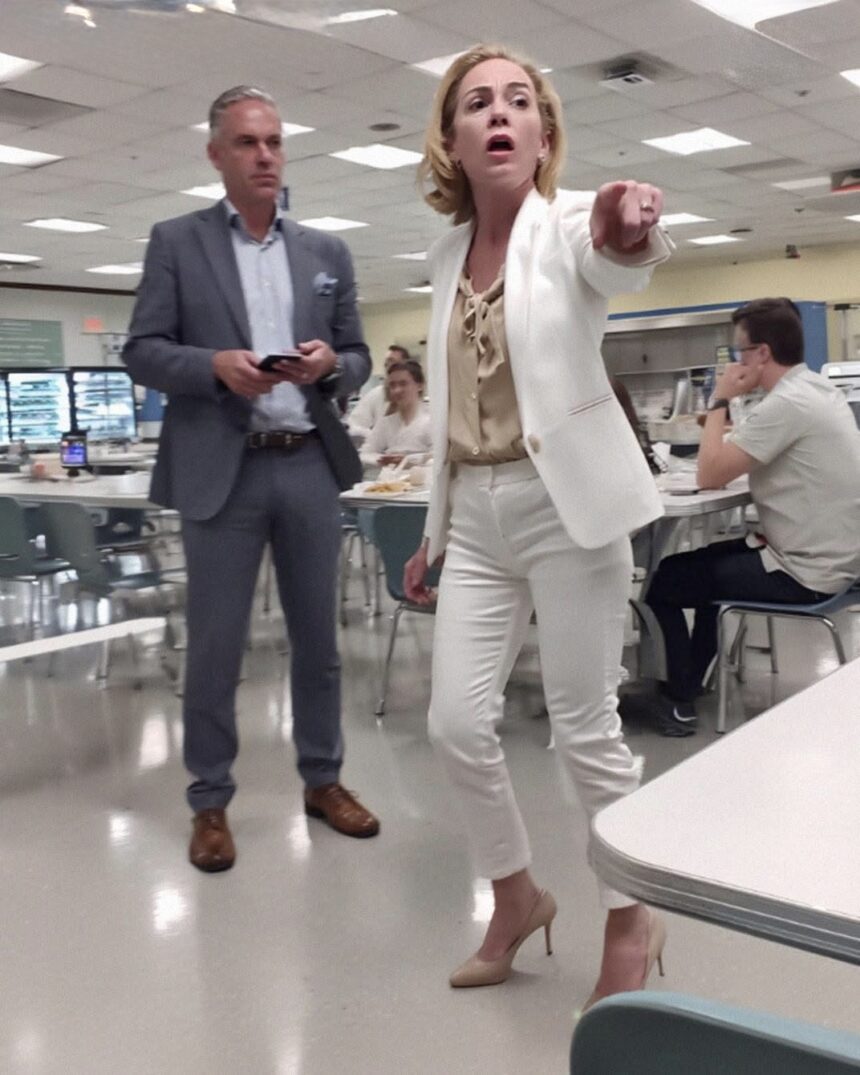
Standing just inside the cafeteria door was a tall woman dressed in an all-white blazer and matching slacks. She looked like she had stepped out of a magazine ad for designer luggage. Her heels clicked against the tile as she stormed in.
Her lipstick was flawless, and not a single hair was out of place. Trailing behind her was a man in a dark suit, probably in his mid-50s. His eyes were glued to his phone, thumb flicking quickly, and he didn’t even bother to look up.
The woman’s eyes landed on me like a missile. “You work here, right?” she said, pointing at me as though I were a misbehaving child. “We’ve been waiting 20 minutes in that hallway, and no one’s come to help.
Maybe if you people stopped stuffing your faces—”
The entire cafeteria went quiet. Forks paused mid-air. The hum of casual conversation died in an instant.
I stood up slowly, sandwich still in my hand. “I’m sorry, ma’am,” I said, trying to keep my voice calm. “I’m on my break, but I’ll find someone to help you right away.”
Her eyes narrowed.
She scoffed like she’d just caught me stealing silverware. “You’re all the same,” she said, loud enough for everyone to hear. “Lazy and rude.
No wonder this place is falling apart.”
My chest tightened, but I kept my tone steady. “I understand you’re upset. Please, just give me a minute.”
She folded her arms and let out a sharp, humorless laugh.
“Oh, I’m sure you understand. You probably enjoy making people wait. Makes you feel important for once.”
Her words cut sharper than she knew.
I took a breath and clenched my fingers to keep them from shaking. Then the man, whom I assumed was her husband, spoke without even lifting his head. “Don’t be too hard on her,” he muttered.
“She’s probably just doing this until she finds a husband.”
My stomach turned. A few people across the room glanced over, then quickly looked away. One young resident from the pediatrics wing looked like she wanted to say something, but didn’t.
I stood there without moving, the sandwich limp in my hand. I wanted to speak up, to defend myself and call out their nastiness, but all I could do was stand there and breathe. A hush had fallen over the room.
Every eye was watching, but no one spoke. Then I saw him. Across the cafeteria, near the coffee vending machine, Dr.
Richard stood up. He was in his early 40s, tall, always well-groomed, with steel-gray hair and a voice that carried. He wasn’t just the head doctor at the hospital; he was someone everyone respected.
He was fair, firm, and never tolerated nonsense. He began walking toward us, a slow, purposeful stride. The kind that made people straighten up just by instinct.
The story doesn’t end here — it continues on the next page.
Tap READ MORE to discover the rest 🔎👇