

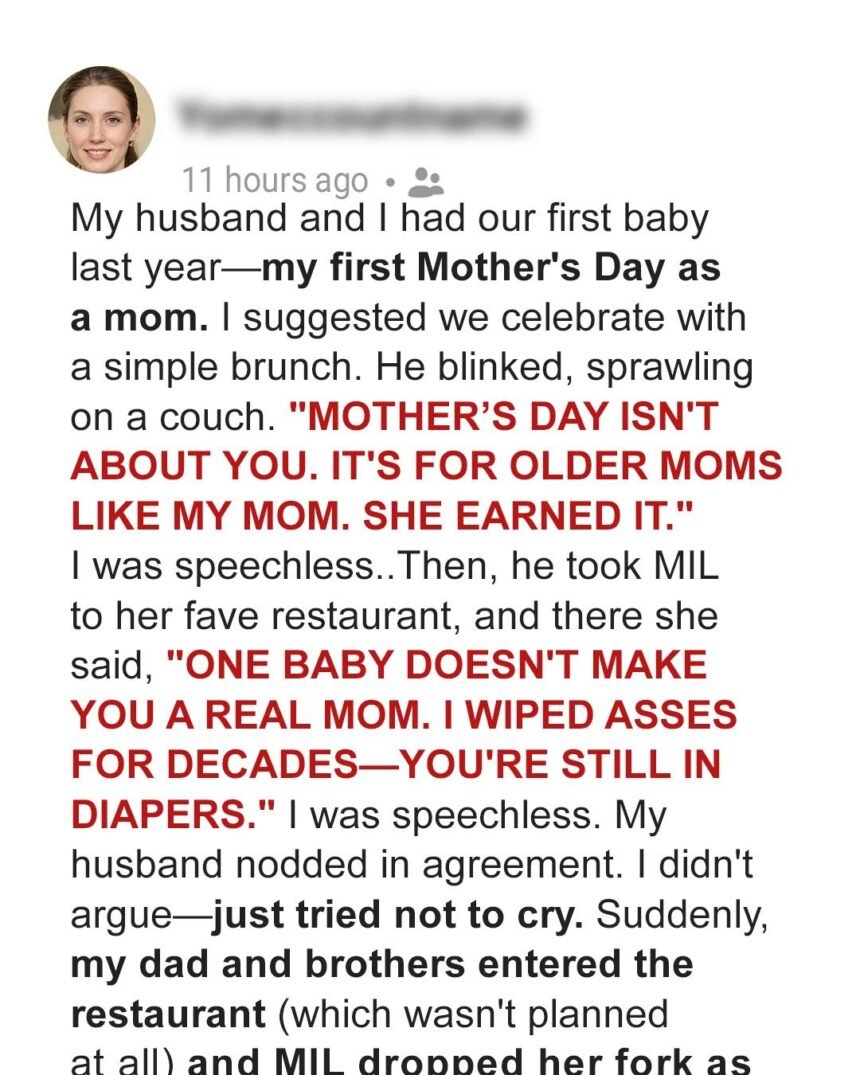
In Sometimes the people who should celebrate you most are the ones who need to be reminded how
My name is Sarah, and eleven months ago, my world split open like a flower blooming in fast-forward, revealing a version of myself I never knew existed. The moment Lily Catherine Williams entered the world—after twenty hours of labor that redefined my understanding of both pain and strength—I discovered that becoming a mother doesn’t just change your life. It changes the very atoms of who you are.
Before Lily, I was Sarah Chen Williams, thirty-one years old, working as a marketing coordinator for a mid-sized tech company, married to Ryan Williams for three years.
I had opinions about sleep schedules (flexible), dinner plans (spontaneous), and weekend activities (whatever felt good in the moment). I thought I understood love because I loved Ryan, loved my family, loved my small but comfortable life.
But holding Lily for the first time, feeling her tiny fingers wrap around mine with that reflexive grip that spoke of million years of evolution, I realized I had been living in black and white. This was color—brilliant, overwhelming, impossible to have imagined beforehand.
The first few months were a blur of feedings every two hours, diaper changes that seemed to multiply like some cruel magic trick, and an exhaustion so profound it felt like a physical weight pressing down on my chest.
Ryan tried to help, but he could sleep through Lily’s cries in a way that seemed biologically impossible to me. My body had been programmed to respond to her slightest sound, to wake from the deepest sleep if she so much as shifted in her crib.
“I don’t understand how you do it,” he’d say in the morning, looking at me with a mixture of admiration and bafflement as I fed Lily while simultaneously making coffee with one hand.
“I don’t either,” I’d reply honestly. “But I do.”
And I did.
Every day, I showed up for this tiny person who depended on me completely. I learned to function on three hours of sleep, to eat meals with one hand while holding a baby with the other, to find joy in the smallest milestones—her first real smile, the way she’d calm down when she heard my voice, the perfect weight of her head resting against my shoulder.
Ryan marveled at these changes in me, though I sometimes wondered if he truly understood them. He loved Lily fiercely, but his relationship with fatherhood seemed more compartmentalized than mine.
He could be a devoted father during the hours he was focused on parenting, then transition cleanly back to work mode or relaxation mode when someone else was watching her.
For me, motherhood was a constant state of being. Even when Lily was sleeping peacefully in her crib and I was theoretically “off duty,” part of my consciousness remained tuned to her frequency, ready to respond if needed.
“You’re such a natural at this,” my best friend Monica had told me during one of her visits. “It’s like you were born to be Lily’s mom.”
Maybe that was true.
Maybe every mother feels that way about her own child. But what I knew for certain was that motherhood had revealed strengths I didn’t know I possessed and depths of love I hadn’t known were possible.
Which is why, as Mother’s Day approached, I found myself hoping for just a small acknowledgment of this transformation—not because I needed validation from others, but because this first Mother’s Day felt like a milestone worth marking.
Donna Williams had been a challenging presence in my life since before Ryan and I were married, though I’d spent three years trying to convince myself that her criticisms were well-intentioned and her cold demeanor was just her personality rather than a reflection of her feelings about me specifically.
At sixty-four, Donna was an elegant woman who took pride in her appearance and her accomplishments as a mother. She’d raised Ryan and his sister Emma as a single mother after her husband left when the children were young, building a successful career in real estate while managing all the responsibilities of parenthood alone.
I respected her achievements and understood why Ryan held her in such high regard.
She had sacrificed enormously for her children and had every right to be proud of how they’d turned out. Ryan was kind, intelligent, and hardworking—qualities that reflected well on his upbringing.
But Donna’s pride in her mothering seemed to come with a possessiveness about Ryan that left little room for other women in his life. During our engagement, she’d made subtle comments about how young and inexperienced I was, how different my background was from theirs, how I probably didn’t understand the kind of commitment marriage required.
“Ryan has very particular needs,” she’d told me once while we were planning the wedding.
“He’s been through so much with his father leaving. He needs stability and someone who truly understands him.”
The implication was clear: I was neither stable nor understanding enough for her son.
After Lily was born, I’d hoped that becoming a mother myself might create some common ground between Donna and me. We were both women who loved Ryan, both committed to his happiness, both invested in raising children who would become good people.
Instead, Donna seemed to view my new role as further evidence of my inadequacy.
The story doesn’t end here — it continues on the next page.
Tap READ MORE to discover the rest 🔎👇