

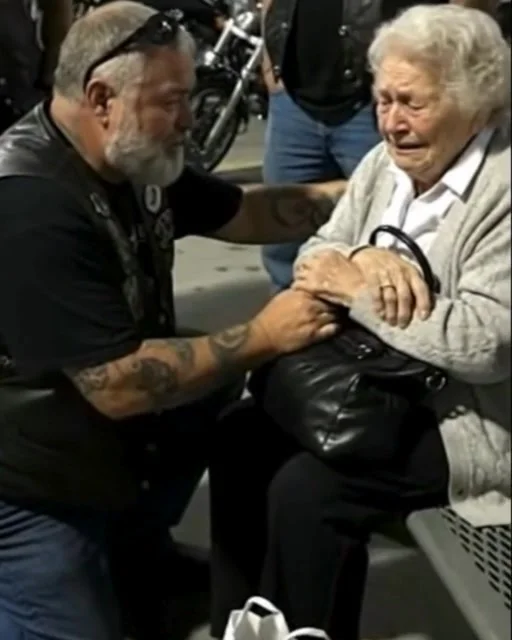
I’d been sitting on that cold bench for three hours, still holding the grocery list he’d written for me. “Get your own stuff, Mom. I’ll be in the car,” he’d said.
But when I came out with two small bags—all my Social Security check could afford—his car was gone. The text came ten minutes later:
“Margaret found a nursing home with an opening. They’ll pick you up tomorrow.
It’s time.”
That’s how my son told me he was dumping me. Through a text. After I’d raised him alone.
Worked three jobs to put him through college. Sold my house to pay for his wedding. I was still staring at my phone when the motorcycles pulled up.
Seven of them. Engines so loud I felt them in my chest. The Savage Angels MC, their vests said.
I tried to look invisible—an 82-year-old woman doesn’t want trouble with bikers. But the biggest one, a mountain of a man with a grey beard down to his chest, walked straight toward me. I clutched my purse tighter.
“Ma’am? You okay? You’ve been sitting here since we went in the store.”
His voice was gentle, nothing like I expected.
“I’m… I’m waiting for my ride.”
“In this cold? How long you been waiting?”
I couldn’t answer. The tears just came.
One of the bikers asked where I live. And when I told them, they exchanged looks I couldn’t quite read. One of them whispered something under his breath, then turned back to me and said:
“Ma’am, we’ve got some business with your son.”
I blinked at him, confused.
“You know Colin?”
The grey-bearded one gave a slow nod. “We know of him. Sounds like he forgot where he came from.”
They offered me a ride, and I didn’t know what else to do.
My knees were stiff, the sun had already dipped below the trees, and the wind was cutting straight through my coat. So I got on the back of one of the bikes—awkwardly, clinging to the man they called “Ox”—and they drove me to my son’s house. When we pulled into the driveway, I half-expected Colin to come storming out.
But the house was dark. Margaret’s car was gone too. Ox walked me to the door and waited while I rang the bell.
No answer. He looked over his shoulder and said, “Fellas, this one’s empty.”
Another biker, a tall woman with short black hair and eyes like stone, turned her head and said, “You sure you want to leave her here?”
I didn’t know her name yet, but her voice was firm. Protective.
“I don’t have anywhere else to go,” I said quietly. And that’s when they made a decision I never saw coming. Ox looked at me, then at the others.
“She’s coming with us.”
I was bundled into a sidecar this time, wrapped in two spare leather jackets, and we roared off toward a place they called “The Den”—a converted warehouse just outside town. Inside was nothing like I expected. There were big leather couches, a fireplace, a massive kitchen, and even a little library.
Not a bottle of whiskey or cigar in sight—just a warm, lived-in space with old photos, patched-up chairs, and shelves full of puzzles and board games. “You hungry, ma’am?” one of them asked. His name was Dutch.
He looked like he’d been carved out of a rock but handed me a grilled cheese sandwich like a butler. I nodded, unable to find my words. That night, they gave me a bed in a quiet room that smelled of cedar and lavender.
I cried myself to sleep—but not out of pain. Out of relief. The next morning, I found a note on the dresser.
“We ride at dawn. Stay as long as you like. – Ox”
I stayed.
Not because I had nowhere else to go—but because for the first time in years, I felt seen. They gave me a nickname—Miss Ellie. Said it suited me better than “Ma’am.” Dutch taught me how to play poker, the woman with the sharp eyes (her name was Frankie) brought me tea every night, and Ox made it a point to check in on me every morning like clockwork.
They didn’t ask for anything in return. But I started cooking breakfast. Cleaning up.
Mending torn patches on their vests. And one night, when a younger member named Reno limped in with a bruised eye and bloody knuckles, I patched him up like I used to when Colin got into scrapes as a boy. “You’re better than any hospital,” he said, wincing as I cleaned a cut near his cheekbone.
“Don’t be silly,” I replied. “I just remember what it’s like to care.”
Weeks turned into months. They told me stories—about the club, about their lives, about the people they’d lost.
Most of them had no family left. Some had left toxic ones behind. It became clear that this wasn’t a gang.
It was a family—just not the kind people expected. One evening, Ox pulled me aside. “Miss Ellie,” he said, “there’s something you should know.”
I tensed, thinking it was bad news.
“Your son?” he continued. “He’s been trying to contact us.”
I blinked. “Why?”
“He heard you were living with us.
Claims it’s dangerous. Says he’s concerned.”
I laughed. Loudly.
“Concerned now, is he? After dumping me like a sack of old clothes in a parking lot?”
Ox smiled gently. “We told him we’d pass on any messages.
But only if you wanted us to.”
“I don’t.”
And that was that. Until three days later, when I walked into the kitchen and found Colin standing there, face flushed, Margaret hovering behind him with crossed arms. “I want her back,” he said.
The story doesn’t end here — it continues on the next page.
Tap READ MORE to discover the rest 🔎👇