
When a lonely nurse breaks the rules at a soup kitchen, a quiet act of kindness sets off a ripple neither woman could have expected. Months later, the letter arrives, rekindling hope, memory, and the quiet truth that sometimes, saving someone else just might save you too. I was 49 the day I realized my house had become too loud in all the wrong ways.
The hum of the refrigerator, the tick of the kitchen clock, and the hollow echo of my own footsteps — they pressed in around me like a fog I couldn’t shake. Some days I’d turn on the TV just to drown out the quiet. Other days I let the silence stretch until it wrapped around me like a blanket I couldn’t crawl out of.
That was the day I stood in my kitchen and cried into the sink. Not because anything had happened, but because nothing had.
Fifteen years earlier, my husband, Oscar, walked out with a suitcase and a vague promise to “find himself.” What he found instead was someone new. And I was left with a mortgage, two toddlers, and a nursing schedule that made sleep feel like myth.
I powered through those years on caffeine, scrubs, and the sharp edge of necessity. There was no time to break down. There was no space to feel sorry for myself, especially not while peanut butter sandwiches needed packing and math homework needed deciphering.
Now, with both kids off at college, their empty bedrooms stared back at me like questions I couldn’t answer. Most nights I’d catch myself setting three plates on the table before I remembered — no one was coming home.
That’s when I started volunteering at the soup kitchen downtown. It wasn’t for charity, and honestly, not even for my soul or to please God…
I just needed to feel useful outside of the hospital walls again. The soup kitchen building was always a little too cold, always a little too loud, with fluorescent lights that flickered when it rained and smelled like a mix of bleach and stale coffee. Most of the mugs were chipped, and every chair wobbled just a bit when you sat down.
The air always smelled faintly of dish soap and damp coats, and the floor was never quite dry near the serving line. When trays clattered or soup sloshed, the whole place seemed to wince in unison. But none of that mattered.
What mattered were the people.
They were tired. Some of them were angry. Some of them smiled more than you’d expect.
But they were human, and they were trying. They showed up with hunger in their bellies and pride in their bones. I admired them more than they knew.
That’s where I met her.
Rachel came in every Saturday morning, always wrapped in the same gray coat and scarf, her hair tucked neatly beneath the fabric. She never asked for anything extra, never raised her voice, and never caused a stir. But there was a gentleness in her, a kind of quiet that made you look twice.
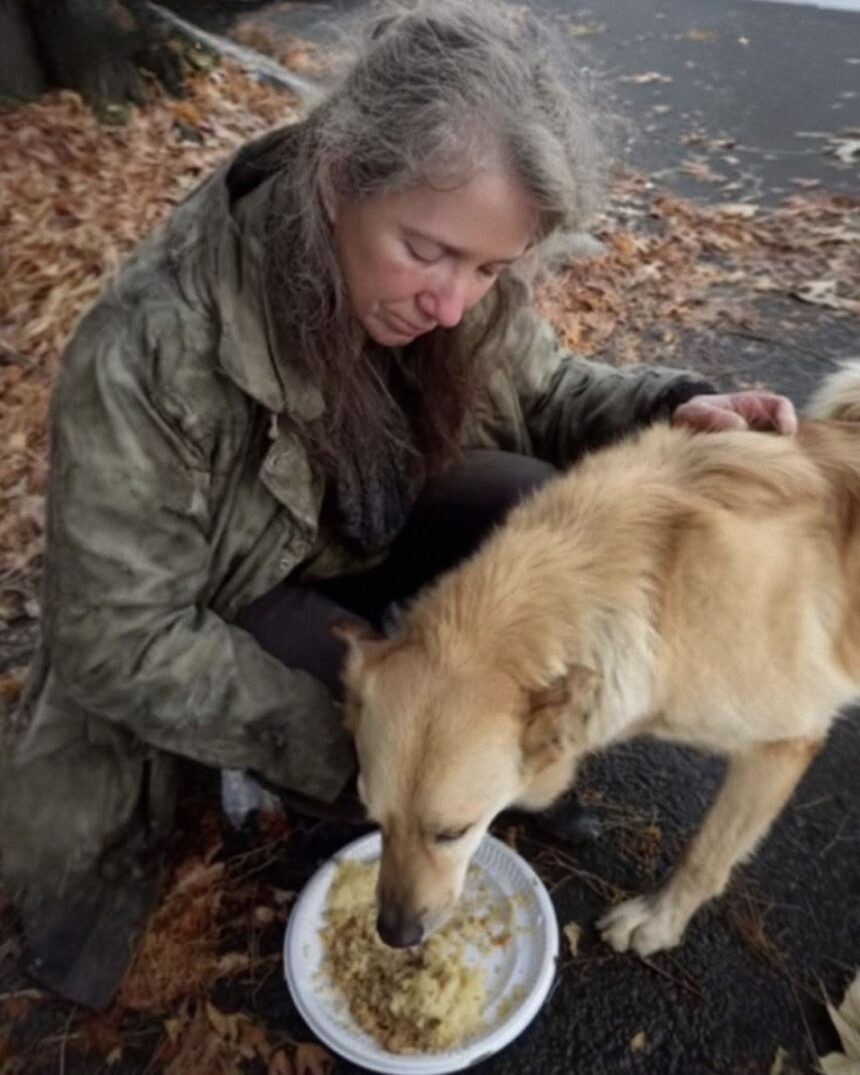
“One for me, and one for someone who can’t come inside,” she’d come up to the counter and say politely. It was barely a whisper — honestly, I probably wasn’t supposed to hear it. Technically, we were only allowed to serve one plate per person.
That was Frank’s rule: one meal, no extras. I had signed a volunteer agreement that spelled it out in bold lettering. But Rachel always looked me in the eye when she said it.
Her voice never shook. She wasn’t lying. There was someone else, and she wasn’t going to leave them out in the cold.
“Two, please,” she’d repeated, just a little louder. “You know I could get in trouble,” I whispered back one Saturday, hesitating with the second plate in my hand. “I know, Anna,” she said, lowering her gaze.
It surprised me that she’d known my name. “I understand.”
But she didn’t walk away. She waited, holding her breath like she was used to being told no.
I handed her the second plate anyway. “Thank you,” she said, her voice softer than before. “You have no idea what this means to me.”
She never lingered after.
She’d clutch both plates like treasure, nod once, and disappear through the back exit. I didn’t ask where she went. I should have.
But I didn’t.
Until the director, Frank, showed up, no one questioned what I was doing. He had gray hair that was always combed straight back, a stiff smile that never quite touched his eyes, and the posture of a man who still ironed his jeans on Sunday afternoons. He came in unannounced one Saturday morning, arms crossed tightly, scanning the room like he was waiting to catch someone breaking a rule.
I saw his eyes land on Rachel. I saw him notice the second plate in her hands, and my stomach churned. Frank’s mouth flattened.
“I saw her feeding a dog,” he snapped. “We’re not here to feed animals. We barely have enough for the people we need to feed.
Come on, guys. You know that.”
I froze, my hands still hovering over the serving tray. All the chatter around us seemed to disappear. “Frank,” I said quietly.
“She’s never asked for anything else. She doesn’t try to take extra bread rolls or ask for more chicken… She just —”
“We have rules, Anna,” he cut in.
“And she broke them. So did you.”
He turned to Rachel, his voice now loud enough for half the room to hear. “You!
You’re done here. Get out. Don’t bother coming back.”
The ladle slipped from my fingers and clattered into the sink. Rachel didn’t argue.
Her eyes were wide, her cheeks flushed, but she didn’t defend herself. She just stood there, as if she’d expected this to happen all along. Then she turned and walked away, her scarf slipping off one shoulder as she reached for the door.
The story doesn’t end here — it continues on the next page.
Tap READ MORE to discover the rest 🔎👇