

“Good things usually are.”
The boy beamed and pointed. “You look fancy, Grandpa!”
Madison chuckled softly under her breath. “Yeah, sure.”
Caroline turned toward me, lips pressed thin.
“Emily, wrap it up. We have real customers.”
I stood up straighter. “He is a customer.”
Her smile disappeared.
“Not the kind who buys.”
The old man stood slowly and brushed off his shorts. He looked at her, not angry, just tired. “Come on, champ,” he said to the boy.
“We’ll go somewhere else.”
The boy frowned, clutching his toy. “But you liked those shoes.”
“It’s alright,” the man said, guiding him toward the door. “Some places just don’t see people like us.”
The bell jingled softly as they left, hand in hand.
Caroline exhaled. “Well, that’s over. Emily, next time, don’t waste everyone’s time.”
Madison smirked.
“Guess you can’t polish poverty.”
I stared after the old man, my fists clenched at my sides. “You never know who you’re talking to.”
Tessa scoffed. “Sure, maybe he’s the president.”
*****
The next morning, Caroline was a mess.
“Corporate visit today,” she barked as we clocked in. “Smile, look busy, and for God’s sake, no mistakes. Don’t embarrass me, okay?”
By noon, she’d already rearranged the shelves three times and snapped at Madison for chewing gum.
We were all on edge. Then it happened. A sleek black Mercedes pulled up in front of the store.
Caroline’s eyes widened. She smoothed down her dress, fixing her hair in the mirror by the register. “Alright, everyone, posture!” she whispered.
“Backs straight, eyes bright!”
The door opened. And my heart stopped. It was him.
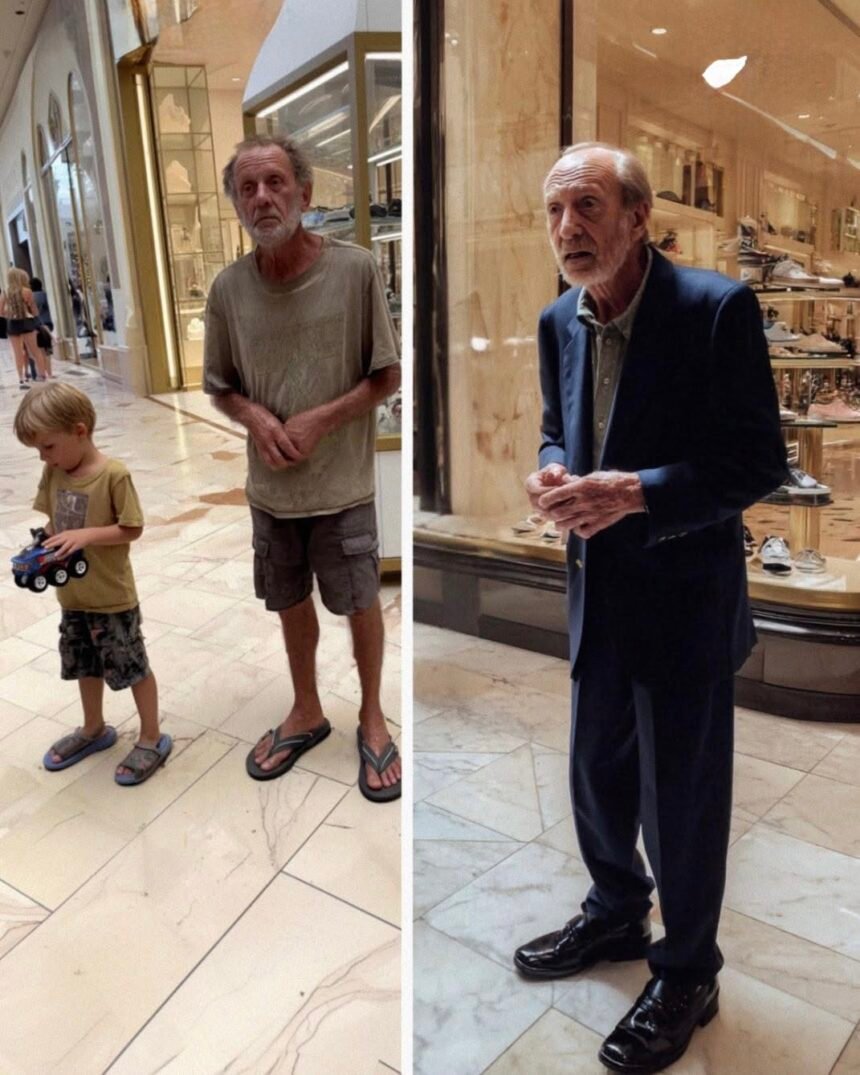
It was the old man from yesterday, but now he looked like he belonged on the cover of Forbes. His white hair was neatly combed and slicked back. He wore a perfectly tailored navy-blue suit, a crisp shirt, and polished shoes that caught the light with every step.
His face was clean-shaven, calm, and unreadable. Next to him stood the same little boy, now dressed in a tiny blazer and slacks, holding the same red toy truck. He clung to his grandfather’s hand like before, wide-eyed and curious, but noticeably more comfortable in this high-gloss showroom.
Behind them, two sharply dressed men followed, each carrying clipboards and wearing dark suits with subtle earpieces. I looked at Caroline. She froze like a mannequin.
Her spine went stiff, her lips parted slightly, but no words came out. Then, finally, she spoke. “Sir…
welcome to Chandler’s,” she stammered, her voice unsteady. “How can we—”
The man looked directly at her, then shifted his gaze past her and looked at me. A faint smile crossed his face.
“It’s you again,” he said. For a second, I thought I had imagined it. But the smile was real, and so was the weight of every pair of eyes turning to stare at me.
Madison’s voice sliced through the silence. “Wait. That’s him?”
He gave a small nod.
“Yes. Yesterday, I stopped by after spending the morning with my grandson. We’d gone fishing.
He loves the water.”
He turned and gently nudged the boy. The child smiled shyly and nodded. “We came in for a quick look.
I wanted a new pair of shoes for a dinner meeting. What I got instead,” he said, his eyes moving around the store slowly, “was a reminder that expensive doesn’t always mean classy.”
Caroline swallowed hard. “Fishing?” she whispered, barely audible.
The man reached into his jacket pocket and slowly pulled out a black leather wallet. It wasn’t flashy, but it looked expensive, the kind of quiet luxury that only stands out if you know what to look for. He opened it and held out a card between two fingers.
“I’m Arthur Chandler,” he said, clear and steady. “Owner and founder of this company.”
The silence in the store was instant and heavy, like someone had shut off all the air. It was as if time paused.
I swear I could hear Madison’s bracelet clink against her wrist as her hand dropped. Madison’s jaw fell open. “You’re Mr.
Chandler?”
He nodded once. “The same man you laughed at.”
Then his eyes landed on Caroline. “Yesterday, you told me these shoes were too expensive for me.
Then you told your employee to ignore me because I ‘didn’t look the part.'”
Caroline’s mouth opened, but no words came out. Finally, her voice cracked. “Sir, I…
I had no idea—”
“That’s the problem,” he said. “You shouldn’t have to know someone’s name to treat them like a person.”
I felt his eyes on me again. My hands were shaking slightly.
“But she did.”
I blinked. “I just… thought you deserved help.”
Arthur gave me the kind of smile that reaches the eyes.
“And that’s all I needed to know.”
He turned back to Caroline, who now looked like she was trying not to pass out. “You’re dismissed. Effective immediately.”
Her hand flew to her chest.
“Sir, please—”
He raised a hand. “No. I built this company on service, not snobbery.
And I meant it.”
His words were quiet but cut like a blade. Then he turned toward Madison and Tessa, who were standing like statues. And you two,” he said, pausing.
“You might consider other industries. Somewhere your attitudes fit better.”
Neither of them spoke. Tessa looked like she was trying not to cry.
Madison actually turned pale. Her lip trembled for half a second before she looked away. Then Arthur looked back at me.
“Emily,” he said, “how long have you been with us?”
“Three months,” I answered, barely above a whisper. He smiled again, this time warmer. “Would you like to stay longer?”
I nodded quickly.
“Yes, sir.”
My heart felt like it might explode. My voice wavered just a little. “Very much.”
“Good,” he said.
“You’re the new assistant manager.”
I blinked. “Sir, what?”
“You earned it,” he replied simply. “Compassion is the best qualification there is.”
The little boy let go of his grandfather’s hand and tugged gently at my sleeve.
“See, Grandpa?” he said, beaming. “I told you she was nice.”
Arthur chuckled softly and placed a hand on his grandson’s shoulder. “You did, buddy.
You did.”
As they turned to leave, I glanced at the counter where Caroline had been standing. She was frozen in place, tears silently streaking her mascara down both cheeks. Her perfect poise was shattered.
Madison leaned closer to Tessa and whispered, “I think I’m going to throw up.”
Neither of them moved. The silence they left behind felt louder than anything. I just stood there, staring at the door that had closed behind Mr.
Chandler and his grandson, unsure whether to sit down or scream into a pillow. Then I noticed something. The tip jar.
It was full, bursting actually, and sitting right at the edge of the register. Inside, folded neatly on top of a crisp $500 bill, was a small note. I picked it up, my hands still unsteady.
It read:
I just stared at it for a while. I didn’t cry. Not yet.
But my chest felt like it was holding back a whole storm. That night, I couldn’t sleep. I lay awake, staring at the ceiling, that note still echoing in my mind.
I kept thinking about how easy it is to mistake kindness for weakness, how often people confuse humility with insignificance. And how just one small moment, one simple choice to be kind when no one else is, can change everything. *****
A week later, I started my new role.
My name badge was updated. I got to train new hires and organize the showroom. I even got to toss out that stupid rule about judging customers by appearance.
But my favorite part? Arthur stopped by sometimes. Usually unannounced.
Always with his grandson. He’d step through the door in a fishing hat, a faded polo shirt, and, of course, flip-flops. I’d grin the second I saw him.
“Fishing trip today?” I’d ask, folding my arms. “Hope no one minds the flip-flops,” he’d reply, winking. “As long as you let me sell you another pair after,” I’d say, pretending to be serious.
He’d laugh. “Deal.”
He always kept his word, too. I had a drawer in the back just for his shoes, the ones he would buy and donate later.
He once told me he didn’t need more than a few pairs, but buying them gave him an excuse to visit. He told me that he wanted people to remember that kindness matters more than wealth, more than image, more than rules. And I did remember.
Every day. There is so much I could say about that day, about what it taught me and how it changed the way I see the world. But at its core, it all comes down to one truth.
The real kind of rich is not about money. It is about character. It is about grace, humility, and how we treat people when there is nothing to gain.
That afternoon did more than shift my career. It opened my eyes. It reminded me that small moments matter, especially the quiet ones when no one is watching and no one expects anything from you.
Kindness is not weakness. It is strength. And how you treat others in those quiet, ordinary moments says everything about the kind of person you are.