
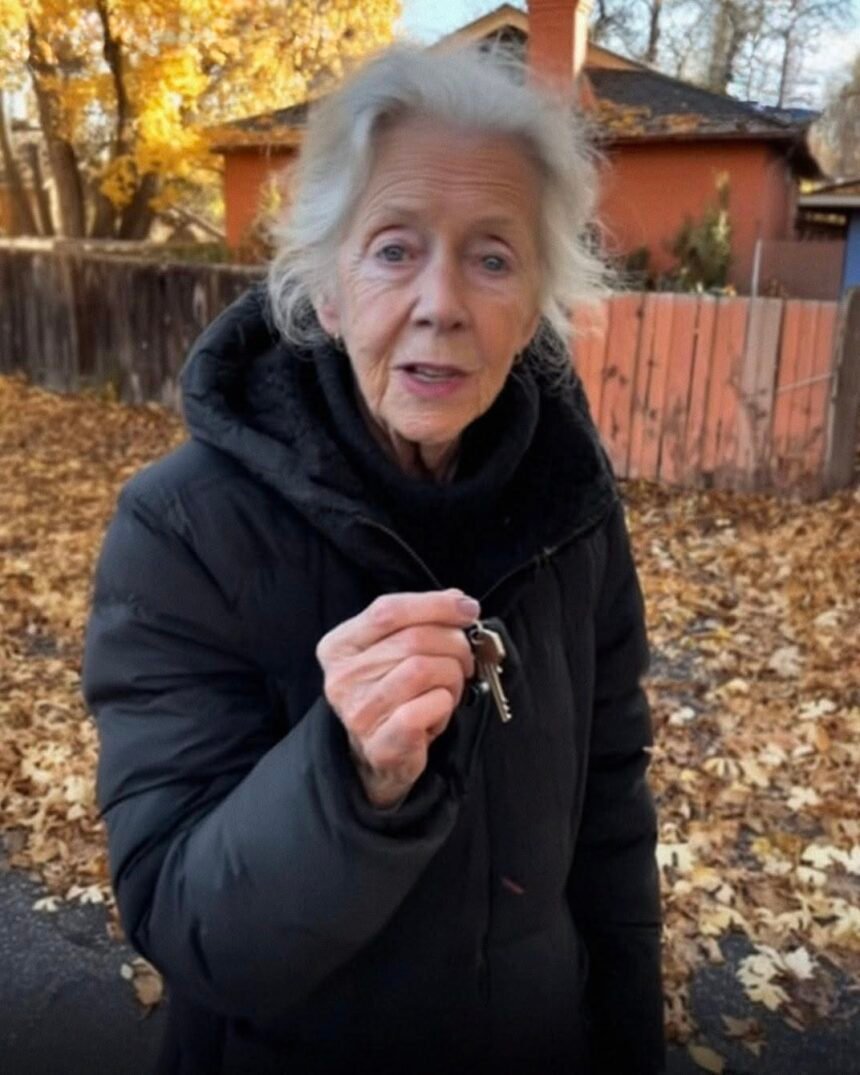
Callahan. “Thank you.”
She gave a faint nod and walked away without another word. I stood there for a moment, staring at the key in my palm.
Then I turned to Paul. “Can you take the car and head home with the girls? I’ll call a cab later.
I just… I need a little more time.”
He looked up from his phone, frowning. “Mira, seriously?”
“I won’t be long.”
He opened his mouth to argue, but something in my face must have stopped him.
“Fine,” he muttered, brushing past me. “Don’t take all night.”
I watched him drive off, then turned back toward the house. My hands trembled slightly as I climbed the staircase.
The wood creaked under my weight, each step louder than I remembered. At the top, I hesitated. The attic door was small, painted over several times, and the knob was slightly crooked.
I slid the key into the lock. It clicked. My heart pounded as I twisted the knob and pushed the door open.
When I unlocked the attic, I didn’t know what I was expecting. Maybe a box of old photographs, one of Grandma’s hidden cookie tins, or even a forgotten treasure from her past. I thought there might be a diary filled with heartfelt memories.
But when I stepped inside, it was just… quiet. The air was dry and smelled like cedar and dust.
The floor creaked beneath my feet as I walked further in. The light from the single bulb flickered once, then steadied. Everything looked ordinary.
Stacks of yellowed books, cardboard boxes labeled in faded marker, a pile of afghans folded neatly in the corner. Then I saw it. A brown leather suitcase was tucked near the far wall, its edges worn smooth from time and use.
I gasped. I remembered that suitcase. I used to climb on top of it when I was little, pretending it was a pirate’s treasure chest.
Grandma would play along, handing me “gold coins” made of wrapped chocolate and laughing every time I yelled, “Aye aye, captain!”
I knelt beside it and slowly unbuckled the latches. Inside were layers of old photo albums and envelopes, some with rubber bands barely holding them together. There were property records, old insurance papers, utility bills, and at the very top, an envelope with my name on it.
The handwriting was shaky, but unmistakably hers. “For Mira,” it read. My throat tightened.
My fingers trembled as I tore it open. The letter began, “If you’re reading this, my dear, it means I’ve left this world. I kept this from you to protect you.
But even from above, I’ll try to keep you safe.”
I swallowed hard, already feeling a weight pressing down on my chest.
She wrote that about a year before she passed, Paul had started visiting her behind my back. I blinked at the words, confused at first. Then I read on.
He told her she should sell the house and move into a care facility. He claimed that we needed the money and warned her not to tell me anything, or else my marriage would fall apart. She said he visited often, always well-dressed and polite on the surface, but there was something cold in his eyes.
At first, she refused. She didn’t want to believe anything bad about the man I had married. But Paul was persistent.
He said things that frightened her, things about our finances, about me, and about losing the house if she didn’t act quickly. Eventually, she gave in. She signed some preliminary paperwork but never followed through on the final sale.
She regretted it deeply and wrote that she was sorry for even entertaining his lies. My eyes burned. My hands were shaking so badly that I had to rest the letter on my knees.
Then came the last part of the letter, in lines I will never forget:
I sat there for a long time, the attic suddenly colder than before. My mind felt numb. I read the letter again.
Then I read it a second time. It felt impossible to believe. Paul, the man who kissed me every night before bed, who helped bathe our daughters, who told me I was the love of his life, had blackmailed my dying grandmother.
I reached into the suitcase and pulled out everything. There was the deed to the house, her will, the signed but incomplete sale agreement, and several other documents that confirmed everything she had written. She had named me the sole beneficiary of the property months before her death.
By the time I climbed back down, the sun had disappeared. I called a cab and carried the suitcase to the curb. I didn’t go straight home.
I stopped at a 24-hour storage facility and locked the suitcase inside one of the smallest units they had. After that, I drove to the bank and placed the most important documents, the will, the deed, and the letter, into a safety deposit box registered under only my name. I didn’t sleep that night.
When Paul walked in the next morning, still in his button-down and tie, I was waiting for him in the kitchen. “Where are the girls?” he asked casually, setting down his keys. “At my sister’s,” I replied, staring at him.
“I needed to talk to you first.”
His smile faded. “Mira, what’s going on?”
I took a deep breath. “Why were you pressuring my grandmother before she died?
What did you need the money for?”
He froze. His lips parted, but no words came out at first. Then he gave a short, fake laugh.
“What are you even talking about? Did someone say something to you at the funeral? You’re tired, Mira.
You’re grieving. I get it.”
“No,” I said, quietly but firmly. “Don’t do that.
Don’t try to gaslight me.”
He shifted uncomfortably. “This is ridiculous.”
“I found her letter, Paul. I found everything.
The deed is in my name. She wrote it all down. Every single thing you told her.”
That’s when I saw it, the flicker of fear behind his eyes.
The mask started to slip. “She misunderstood,” he said quickly. “I never forced her.
I was just trying to help. The house needed work, and we’re not exactly swimming in cash, Mira. You know that.”
“Why didn’t you come to me?”
“I was trying to protect you.
The investment… it was supposed to fix everything.”
I narrowed my eyes. “What investment?”
He hesitated.
“You might as well tell me the truth now,” I said. “Because I already know you lost money. What I don’t know is how much and where it went.”
He sat down heavily at the kitchen table, burying his face in his hands.
“A year ago,” he began, “a guy from work — Jason — said he had an inside scoop on this crypto startup. Guaranteed returns. Triple what we’d put in.
I thought if I could turn a quick profit, we could finally stop worrying about the mortgage, Ellie’s preschool tuition, all of it.”
“So you gambled our savings?”
“Two-thirds of it,” he said quietly. I felt like the air had been knocked out of me. He continued, “And when it crashed, I panicked.
I started moving money around. Told you we had some extra tax bills and that the roof needed work. I thought I could fix it before you ever found out.”
My hands clenched into fists.
“So instead, you went behind my back and tried to bully a 92-year-old woman into selling her home — the only place that’s ever felt like mine?”
“I didn’t mean for it to go that far.”
“But it did. And you lied to me. You lied for a year.”
He stood up, walking toward me.
“Mira, please. I know I messed up. But I did it for us.
For the girls. Don’t throw our whole life away because of one mistake.”
“One mistake?” I laughed bitterly. “You stole our savings.
You manipulated my dying grandmother. You made me question my own grief. That’s not a mistake, Paul.
That’s who you are.”
We argued for hours. I yelled. He cried.
He begged me not to ruin our family and said he would make things right. He promised to get therapy, to come clean about everything, and to never lie again. But I couldn’t even look at him.
That night, I slept on the couch. The next morning, I called a lawyer. By the end of the month, the divorce papers were filed.
I didn’t shout or slam doors. I let my attorney handle the mess, and I made sure the girls stayed shielded from it all. Paul moved out two weeks later.
I kept the house. The one that was never his to begin with. I had the locks changed.
I repainted the living room. I found an old photograph of Grandma and me baking together and placed it on the mantel. I framed her letter and set it up in my home office, not as a reminder of betrayal, but as a reminder of love.
Because in the end, she protected me. Even from the man who once promised he would never hurt me. And that, more than anything, is what saved me.