
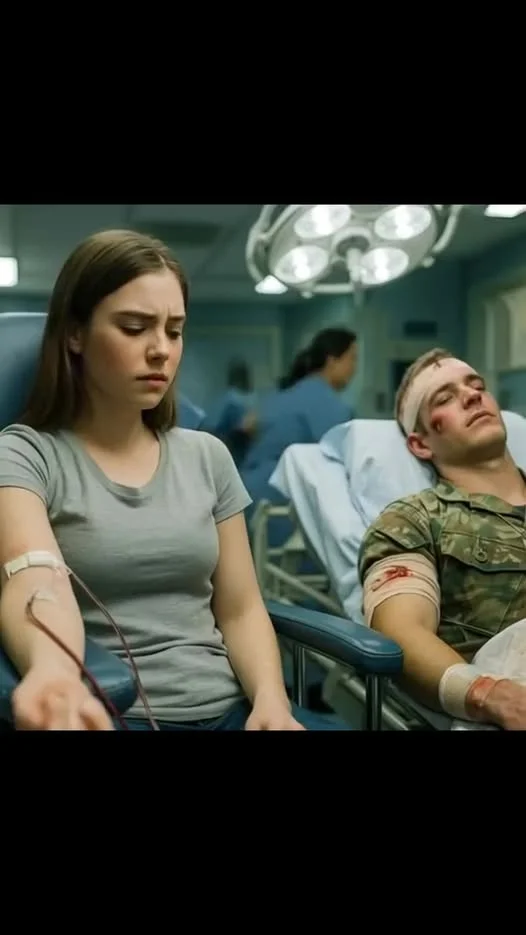
The emergency room was chaos that night. The smell of antiseptic clung to the air, sharp and overwhelming, barely masking the metallic tang of blood. Monitors wailed like alarms, and the doors burst open as paramedics rushed in a young Marine whose body looked more broken than whole.
His uniform was shredded, his skin drained of color, and the stretcher beneath him was slick with red. Doctors barked orders, nurses scrambled, and for a moment the world felt suspended on the razor’s edge between life and death. I wasn’t supposed to be there for anything serious.
I was in the waiting area, clutching a clipboard with routine paperwork for my own minor check-up. My biggest worry that evening had been the long wait and the hum of fluorescent lights buzzing overhead. But in a single instant, that all fell away.
“AB-negative!” a nurse cried, her voice slicing through the room like a command. “We need AB-negative right now!”
The words struck me like lightning. My chest tightened, and for a second I thought I might collapse where I stood.
AB-negative. That was me. The rarest of the rare, just one percent of the population.
My first instinct was to shrink back. The last time I’d tried donating blood, I fainted before the needle even came out. My veins had always been difficult, my body prone to betraying me.
I had spent years telling myself I wasn’t built for that kind of sacrifice, that my weaknesses made me unsuited for moments like this. And then I saw it: the dog tags dangling from his neck as they wheeled him past. His chest heaved shallow, erratic gasps, the kind of breath that sounds like it could be the last.
The life inside him was slipping away in plain view. If I stayed silent, if I let someone else step forward, that Marine wouldn’t see another sunrise. So I swallowed my fear and forced my voice to work.
“I’m AB-negative,” I said, though it trembled as the words left me. “Take mine.”
The nurse’s eyes locked onto mine, wide with urgency. Within seconds, I was hustled into a chair.
A swab soaked my arm in cold alcohol, a tourniquet tightened, and before I could rethink, the needle was in. The sting barely registered before the dizziness hit. My vision blurred, the overhead lights searing my skull, and I clenched my fists so hard that my nails carved crescents into my palms.
Anything to keep myself conscious, to keep going. Across the room, the Marine lay surrounded by surgeons. His pulse monitor beeped in terrifying irregularity, each dip making my stomach twist harder.
I wanted to close my eyes. I wanted to let the blackness take me. My body screamed at me to stop.
But each drop that left me was a chance for him to live. “Stay with us,” one of the doctors muttered. I couldn’t tell if he was speaking to the Marine or to me.
Maybe both. And then it happened. The jagged beeps of the monitor steadied, settling into a fragile but steady rhythm.
His chest rose with deeper breaths. His color, faint as it was, began to shift back from ghostly white toward something alive. I didn’t realize I was crying until a nurse brushed my damp forehead and whispered, “You did it.
He’s stable.” Relief flooded me, so heavy it pulled me under. The noise of the ER dissolved, the lights dimmed, and I finally let go. When I woke, it was morning.
The hospital ceiling loomed above me, the hum of machines still in the background. My arm was bandaged, my body aching like I had run through fire. A doctor told me the Marine had made it through the night.
Without the transfusion, he wouldn’t have. I nodded, too exhausted to speak. To me, it felt simple.
He needed it, I had it, and that was the end of the story. I went home with no expectations. Maybe a call one day with an update.
Maybe silence. But the next morning, before I had even finished my coffee, a deep rumble echoed down my quiet street. Engines.
A black SUV pulled up in front of my house, and two Marines stepped out, uniforms pressed and polished. Then a third figure emerged — taller, older, chest glittering with medals that caught the sunrise like fire. Four stars lined his shoulders.
My coffee cup trembled in my hands as the man climbed my porch steps. He removed his cap, tucked it under his arm, and looked at me with eyes as sharp as steel. “Ma’am,” he said, his voice deliberate and commanding.
“I’m General Lawson.”
I managed only a nod, too stunned to find words. He studied me for a long moment before continuing. “The young man you gave your blood to — that Marine is one of mine.”
My throat closed, tears threatening again.
“You saved his life,” Lawson said. “We owe you more than thanks.”
I stammered, “I just did what anyone would have done.”
The general’s gaze softened. “No, ma’am.
Most wouldn’t. You bled for a stranger. You carried him when the battlefield already tried to take him.
That is not ordinary.”
Behind him, the Marines stood like statues, but their eyes betrayed something unexpected — respect. A weight settled on me: the bandage on my arm, the weakness in my legs, the magnitude of what had happened. Then Lawson extended a heavy envelope sealed with the Marine Corps emblem.
“I came here personally because a letter wasn’t enough. This is an invitation. The Corps would like to honor you tomorrow at headquarters.”
The next day, I stood in a hall draped with flags and filled with uniforms.
The story doesn’t end here — it continues on the next page.
Tap READ MORE to discover the rest 🔎👇