

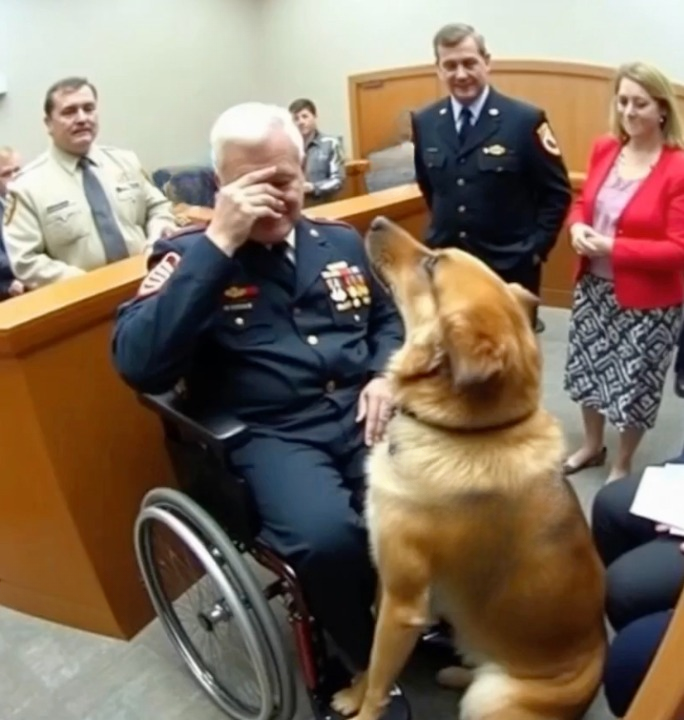
The morning air outside the courthouse was crisp, carrying the faint hum of city life. Inside, however, the atmosphere was entirely different — still, watchful, and charged with an undercurrent of emotions. Rows of benches lined the courtroom, each occupied by individuals waiting for their cases to be heard.
In the front row, Sergeant Nathan Carter sat in his wheelchair, his hand resting gently on the head of his German Shepherd, Thor. Thor wasn’t just a pet. He was Nathan’s partner in service, his constant companion through long deployments, sleepless nights, and moments of danger few could fully understand.
Together, they had navigated dusty combat zones, crowded checkpoints, and unpredictable patrols. In those moments, Thor had been Nathan’s eyes, ears, and sometimes even his courage. Today, however, their situation was unlike anything they had faced before.
This was not a battlefield, but a legal proceeding. The question at hand was whether Thor, who had served as a military working dog, would remain with Nathan or be reassigned under government protocols. The official classification labeled Thor as “government property,” a term that sounded cold and impersonal compared to the years of shared loyalty between man and dog.
Nathan’s injuries, sustained in active service, had left him partially paralyzed. Through rehabilitation, Thor had remained by his side — steadying his movements, offering support, and silently keeping watch over him. But regulations often follow rules before relationships, and the law didn’t always account for bonds like theirs.
As the judge entered, the courtroom fell into a deep, respectful quiet. Everyone rose, then sat again in unison. The sound of chairs scraping the wooden floor echoed briefly before fading into the stillness.
The judge, a composed woman with silver hair and a deliberate manner, began reviewing the case file. Nathan kept one hand on Thor’s leash, the other resting on his lap. The proceedings began with procedural formalities: reviewing documents, hearing statements, and clarifying timelines.
Nathan’s attorney spoke about the years of service Thor had given, both in combat and in aiding his recovery. Several witnesses attested to the strength of their bond, recalling moments where Thor’s actions had been nothing short of life-saving. As the testimony unfolded, Thor remained calm — his posture straight, his ears occasionally twitching at sounds in the room.
But there was an alertness in his eyes, the kind that came from years of training and instinct. To Thor, every environment was one to be assessed, every sound worth evaluating. When the time came for the judge to deliver her decision, Nathan’s heart was heavy.
He had prepared himself for the possibility that today might be his last day with Thor. He wanted — at the very least — to say goodbye properly, to let Thor know, in whatever way dogs understand, that their time together had meant everything. But then, something shifted.
Thor’s head turned sharply, his gaze locking on a point near the rear of the courtroom. His ears stood fully erect, his body tensing in a way Nathan instantly recognized. These were not signs of aggression, but of focus — intense, unyielding focus.
It started as an ordinary morning—a quiet goodbye to my father at the cemetery. But by the next day, I found myself sitting in a police station, accused of a crime I didn’t commit. All because of my kind gesture toward an elderly blind woman.
Grief has a peculiar way of dulling time. Days stretch into weeks, and yet, every memory feels as sharp as a blade. It had been six months since I lost my father, and though life went on, the pain lingered.
I found solace in visiting his grave every week, sharing with him the things I could no longer say in life. That morning, the air was crisp, a gentle breeze rustling through the cemetery’s towering oaks. I stood by his grave, holding a bouquet of white lilies, his favorite.
“Goodbye, Dad,” I whispered, brushing away a tear. As I turned to leave, I noticed a frail figure standing a few rows away near a freshly dug grave. An elderly blind woman, dressed in a simple black dress, clutched a white cane.
Her dark glasses hid her eyes, but the slump in her shoulders spoke volumes. “Excuse me, ma’am,” I said softly, approaching her. “Do you need help?”
She turned her head in my direction, her lips curling into a faint smile.
“Oh, thank you, dear. I’d appreciate it if you could walk me home. My sons were supposed to pick me up, but I think they’ve forgotten.”
I felt a pang of anger on her behalf.
Who abandons their blind mother at a cemetery? “Of course,” I said. “I’d be happy to help.”
As we walked down the quiet streets, she introduced herself as Kira.
Her husband, Samuel, had passed away just days before. “He was my world,” she said, her voice trembling. “We were married for forty-two years.
Losing him…” She trailed off, her words swallowed by the weight of her grief. I squeezed her arm gently. “I’m so sorry for your loss.”
“They didn’t even wait with me at the cemetery,” she continued bitterly.
“My sons, Ethan and Mark. They said they’d come back in half an hour, but I waited two hours. Samuel always said they’d be the death of me, but I didn’t want to believe him.”
Her words hinted at a deeper rift, but I didn’t press.
The story doesn’t end here — it continues on the next page.
Tap READ MORE to discover the rest 🔎👇