
A Street That Thought It Knew Itself
The sun had barely cleared the chimneys on Oak Street when I stepped onto my porch with a mug of coffee and a mind already plotting rescue strategies for my wilting petunias. At seventy-four, I’ve learned dawn is when a neighborhood reveals its character—before engines growl, before leaf blowers whine, before opinions get louder than the birds. I’m Eleanor Walsh.
I’ve lived on this block for thirty-five years, long enough to see training wheels come off and grad caps go on, long enough to know that fences don’t make neighbors; kindness does.
The Man in the Leather Vest
Three days earlier, the old Murphy house finally found a new owner. He arrived without fanfare: a well-kept pickup, a Harley, and a pace that suggested a back no longer surprised by heavy lifting. He looked mid-sixties, tall, gray-bearded, the quiet kind of strong.
His leather vest was studded with patches I couldn’t read from my side of the street, and his nod—when our eyes met—was respectful, not inviting. Some people speak in paragraphs; this man seemed to speak in periods.
The Watcher at the Window
Not everyone was content to let introductions happen naturally. Across from the new arrival lived Gladys Henderson—Oak Street’s self-appointed gatekeeper and aerial surveillance unit.
She patrolled her bay window with binoculars and an iron certainty that “standards” were a species on the brink. “Eleanor,” she’d hissed over our shared fence, “that biker is going to bring trouble.” I’d said what I always say when fear dresses up as foresight: “Perhaps say hello before you say no.”
Coffee Turned into Code Red
That Tuesday, the new neighbor took his coffee to the driveway and sat astride his Harley as if it were a pew, watching the sky warm from pewter to gold. He didn’t start the engine.
He didn’t rev. He just watched the light. Then sirens carved the morning like knives.
Three cruisers. Six officers. Commands.
Palms raised, thermos set down, a face that said, I know this drill; I wish I didn’t.
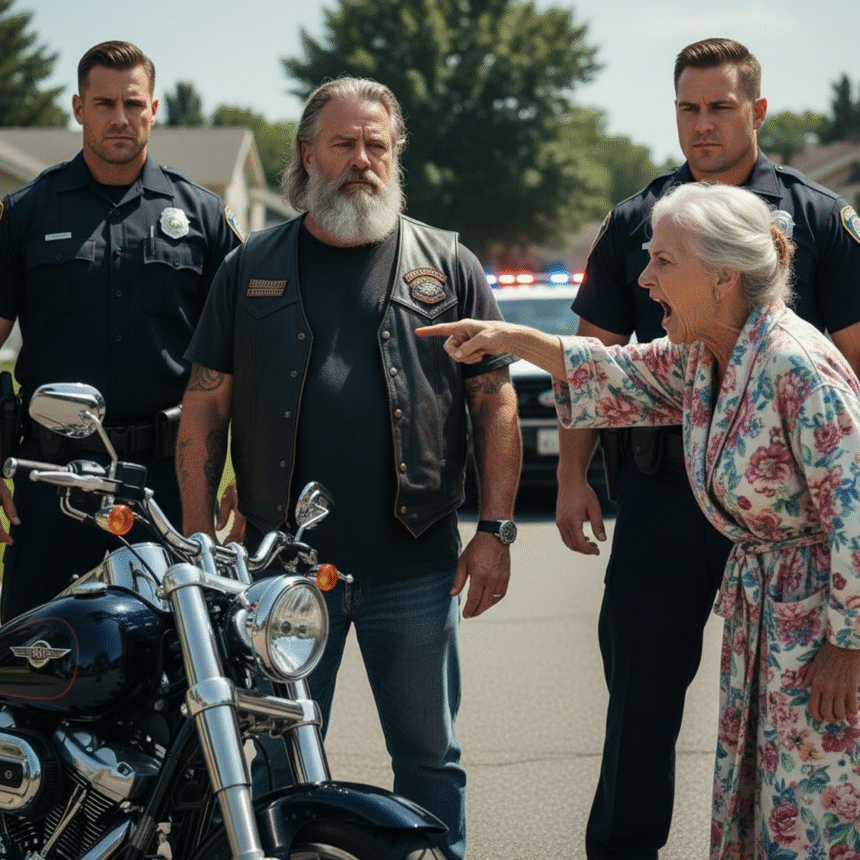
“We got a call about a suspicious person casing houses,” the lead officer said.
“I live here,” the man replied evenly. “This is my driveway. That’s my porch.”
Gladys burst from her door, pointing with the fierce relief of someone who thinks calamity confirms her instincts.
“That’s him! He’s been sitting there for twenty minutes. Planning something.”
The Reveal That Reset the Block
The biker’s jaw flexed, then unclenched.
He spoke to the officers, but his words carried to all of us.
“Master Sergeant Daniel Morrison, United States Army, retired. This house is mine—bought with a VA loan. Those patches?
Warriors Watch. We’re combat veterans who ride to raise funds and awareness for suicide prevention.”
If words could turn a tide, those did. Hands lifted from holsters.
The lead officer returned his ID. Apologies hovered but didn’t quite land. Gladys retreated, a storm cloud searching for a new horizon.
Daniel lifted his thermos again, steady as bedrock, and took a long sip of cold coffee.
I crossed the street.
“Sergeant Morrison,” I said, offering a hand. “Eleanor Walsh. I’m sorry you were treated like that.
That’s not who Oak Street is—at least, it’s not who Oak Street should be.”
“Thank you, Mrs. Walsh,” he said. “I came here for quiet.
Seems I brought a little training with me, too.”
A Campaign Meets a Wall
Over the next week, the pattern hardened. Anonymous calls about “noise.” Complaints to the HOA about his flag (proper), his lawn (precise), his visitors (veterans with more courtesy than most book clubs). Through it all, Daniel remained composed, documenting and responding with the discipline of a man who’d learned that anger wastes oxygen.
He mowed with parade-ground stripes, carried Mrs. Patterson’s groceries, and rescued trash cans cartwheeling in a storm. He was visible in all the ways that keep a street safe—present, steady, aware.
A Fall, a Cry, a Choice
The turning point arrived with a scream.
Gladys lay at the foot of her steps, leg twisted, shock stealing color from her face. Her phone had skittered out of reach. I was moving, but my knees were honest about our limits.
Daniel reached her first—field-calm, voice low, hands already problem-solving.
“Mrs. Henderson, don’t move. You may have a fracture.”
“Don’t touch me!” she gasped, panic shoving past pain.
“I’d prefer not to,” he said gently, “but you need help.”
He called 911 and described her condition with the clean precision of triage.
He slid off his leather vest—the one she’d named “evidence”—and wrapped it around her to slow the chill of shock. He steadied her head, immobilized her leg with porch cushions I fetched with shaking hands. When paramedics arrived, they praised his stabilization.
“Combat medic,” he said simply. “Twenty years.”
“Why are you helping me?” she whispered as they lifted her.
“Because that’s what we do,” he answered. “Because you’re my neighbor.”
When a Street Learns to Blink
In the wake of the ambulance’s howl, Oak Street exhaled.
Apologies came first in clumsy handfuls, then in steady streams. Mr. Patterson admitted he’d been “swayed by noise, not facts.” Carol from the corner house said, “You’re less loud than my blender.” Daniel absorbed it all with a nod that functioned like a bridge: sturdy, unadorned, built to be crossed.
The story doesn’t end here — it continues on the next page.
Tap READ MORE to discover the rest 🔎👇