

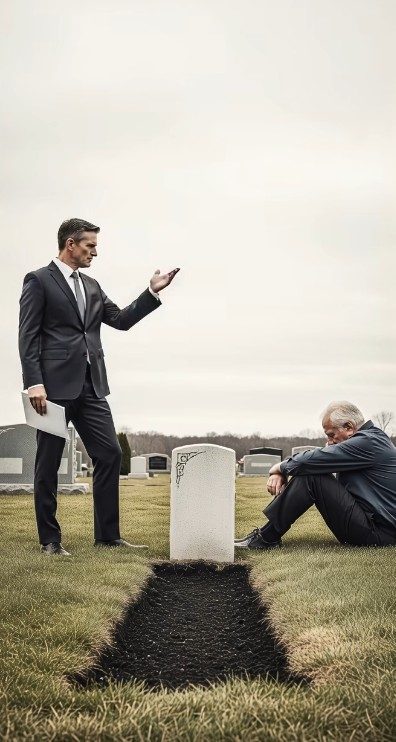
The funeral flowers had only just begun to fade when the calls started. I was in my kitchen on a Thursday morning, two weeks after we buried Helen, watching the steam curl from a mug I hadn’t touched. It was a Father’s Day gift from my granddaughter, Emily, years ago, but now it felt heavy, foreign, like it belonged to a man I no longer was.
Everything felt foreign. “Dad, we need to talk about the house.” My son Mark’s voice on the phone carried the same restrained impatience he’d had as a teenager asking for money. Only now, at 38, he wasn’t asking.
“Good morning to you, too, Mark.”
“Don’t start with me,” he said. “Laura and I have been talking. This place is too big for you alone.
The taxes, the upkeep… it’s not realistic. We’ve already found a buyer.”
“There is no mortgage,” I said, the words flat, factual. Helen and I had paid it off six years ago.
I’d never told the kids. They assumed, and I let them. A short, sharp laugh.
The same one he’d inherited from me, though I’d never used it like a blade. “Dad, please. Mom’s pension barely covered her medications.
We all know you’re under strain.”
I looked out the window at the garden Helen and I had tended for 25 years. The rosemary, the lemon tree—every plant had become a monument to what I’d lost. “You’re worried about me?” I asked.
“Is that it?”
“I’m worried about what’s practical,” he replied. “We could put the money from the sale to good use. Laura’s got Emily’s tuition, and…”
I stopped listening.
I could see him at his dining table, a spreadsheet glowing on his laptop, columns labeled: Dad’s House Sale, Proceeds, Split. I had taught him numbers when he was eight, making him calculate change for the ice cream truck. Now, he was calculating me.
“Mark,” I said, my tone even, “you’ve been planning this.”
“That’s called being responsible,” he countered. “We can’t just sit around until something happens to you.”
The sentence hung there, ugly and unpolished. Until something happens to you.
“Thanks for your concern,” I said, my voice flat. “I’ll think about it.” I ended the call before he could sell me my own life in bullet points. The house was quiet again, but the silence had changed.
It was no longer the stillness of mourning; it was the pause between one blow and the next. The phone rang again. My daughter, Laura.
“Dad,” she began, her voice pitched a little too high, the way it got when she was trying to make bad news sound like a gift. “Mark and I are on the same page. We think…”
“You both think I should sell the house,” I finished for her.
“It’s for the best. You could move in here! We’ve got the finished basement, a full bath.
Mark says we could add a kitchenette. You’d have your own space. It’s perfect.”
Perfect.
A word too big for four walls below ground. “And the money?” I asked. “Well, after we cover the contractor for the basement, you could set some aside.
Help with Emily’s tuition, maybe help Mark with his new place. It’s all family, Dad. A win-win.”
Win-win.
I could hear the echo of Mark’s voice in hers, the rehearsed cadence of people who had already agreed on the ending. “Laura,” I said, “when was the last time you called me to talk about something other than money?”
“That’s not fair,” she protested. “It’s been two months,” I said.
“It’s been two months since you called for anything else.”
“You’ve been sending Emily money every month!” she blurted, as if it were an accusation. “Yes,” I said. “Five hundred dollars, for two years.”
“She doesn’t need to know that,” Laura said quickly.
Of course not. If Emily knew, she might question the stories she’d been told about her fragile old grandfather who couldn’t manage his own affairs. I hung up.
For a long time, I just stood in the hallway, staring at Helen’s reading glasses, still folded neatly on a paperback she’d never finish. My feet carried me to her study. The room smelled of lemon oil and the faint trace of her perfume.
Her desk was exactly as she’d left it. I pulled open the stiff bottom drawer and my fingers found the edge of a pale blue folder. It was heavier than it looked.
On the front, a yellow sticky note in Helen’s tidy block letters: If you’re reading this, you need to know what’s inside. I sat there, the late morning light warming my face, and for the first time since the funeral, I felt something other than loss. It wasn’t hope, not yet.
But it was direction. The first thing I saw inside the folder was a sheath of financial statements. Bank accounts I didn’t recognize, all in Helen’s name.
Under them, a deed for a villa in the Algarve region of Portugal, purchased ten years ago. Owner: Helen Margaret Hale. No mention of me.
A letter from a law firm in Lisbon confirmed its current value and offered to manage a rental contract. Helen had declined in a handwritten note at the bottom: Not yet. Keep private.
Private? The word sat there like a pebble in my shoe. There were more documents.
Life insurance policies I’d never seen, the largest naming only one beneficiary: Emily. Then I found the letter, dated two years ago, in Helen’s looping cursive. Richard, it began, if you’ve found this, I’m gone.
And if I’m right, the calls have already started. They will circle you, not because they need you, but because they want what you’ve built. You’ve always given them the benefit of the doubt.
The story doesn’t end here — it continues on the next page.
Tap READ MORE to discover the rest 🔎👇